
By Madison Blair
In the Middle Ages, chivalry was at the core of everyday life for: it had great influence on how a chivalrous man carried himself, from his honor, to how he interacted with those with less power, even to love. While the concept of fin amor, or courtly love, is often romanticized, it actually stems from chivalry. Courtly love is a knight’s devotion to a woman, usually married and of high status (Mark). Courtly love could be simply flirtatious, or it could be sexual. In a world of knights and chivalry, women had no place other than to encourage mens’ honor. Courtly love elevated women’s status in society by making them the object of knights affection, as it was their duty to be devoted practically in every way to the woman (Mark).

History
Courtly love is largely debated by medieval scholars. It is unclear whether it is a Medieval literary trope or an actual model of relationships, though one theory debated by scholars is that it was a religious allegory for the heresy of Catharism (Mark). Though the term was not coined by French philologists until the late 19th century, the concept started appearing in Medieval literature as early as the 1100s. It was said to have been popular between the 1300s and 1500s, when arranged marriage for wealth and success were at their prime (“Medieval Courtly Love”). This type of poetry first gained popularity on behalf of the troubadours, “poet-minstrels who were either retained by a royal court or traveled from town to town” (Mark). Some scholars say that William IX, who wrote poetry focusing on women and romance, was the first of the famous troubadours. After that, many poems would be published about what we now know as courtly love, then referred to as fin amor.
Courtly love and chivalry
Courtly love is a direct relationship with the code of chivalry. Because women were supposed to guide men in their chivalric duties, women were pursued in courtly love. It was a seemingly equal trade: women encouraged chivalry, and men would therefore devote themselves entirely to a woman. A common example of a courtly love relationship in medieval literature is Guinevere and Lancelot. Lancelot, a knight in King Arthur’s court, is in a romantic relationship with Guinevere. Lancelot is chivalrous to a fault, and part of this is because of his love for Guinevere, as she allows him to become more chivalrous (Ashe). Courtly love was a tactic to bring out a man’s nobility and honor.
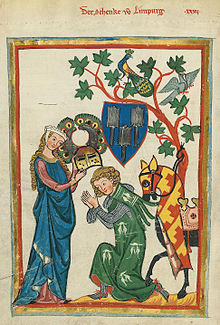
Popular pieces of courtly love literature
Courtly love poems were the Middle Ages version of romance novels. They were so popular because they allowed women an escape from their marriages, which were often arranged, and gave men a chivalric cause. Stories about courtly love could be found through many different forms: ballads, poems, short stories, etc. Geoffery Chaucer is one of the most famous producers of these types of stories (“Medieval Courtly Love”). His story “The Miller’s Tale” highlights all of the key features of courtly love, such as all-encompassing love and jealousy. More popular examples of courtly love are the lais of Marie de France and some Arthurian tales. Perhaps one of the most popular writings on courtly love, however, comes from Andreas Capellanus, a chaplin from the 12th Century. In his work “De Amore”, Capellanus outlines a set of rules to be followed in relationships of courtly love (“Rules of Courtly Love”). This guideline for those engaging in courtly love could indicate the truth of its existence, or it could be playing into the popular literature of the time.
The Rules of Courtly Love
The rules outlined by Andreas Capellanus in his piece “De Amore” is the most popular set of guidelines for courtly love. In his lists, he spells out thirty-one rules that men and women engaging in fin amor must follow. The following rules are taken from “De Amore” in order of appearance in the original writing, and is only a brief selection.
- Marriage should not be a deterrent to love
This rule highlights the institution of courtly love. Since most courtly love flirtations and relationships occur while the woman is married, it makes sense to see this on Capellanus’s list.
5. That which is not given freely by the object of one’s love loses its savor
I found this rule to be surprisingly progressive for the time period. In essence, Capellanus is saying here that if she is not interested, the man needs to back down. This could be a nod to early feminism, or an attempt for the man to save his pride.
13. Public revelation of love is deadly to love in most instances
Number thirteen seems to go against modern day romance as we know it, and insists on keeping love a secret, or hidden from the outside world. This was done probably in part to protect the knight from the woman’s husband.
17. A new love brings an old one to a finish
This is basically saying that by falling in love with someone new, feelings for the old romantic interest will just disappear. I found this interesting, as it can be seen as a reason to jump quickly and hastily into a new relationship.
21. Love is reinforced by jealousy
Here, Capellanus argues that without jealousy, love cannot exist. I found this rule to be ironic, as most courtly love relationships occur when the woman is in a committed relationship with her husband.
31. Two men may love one woman or two woman one man
Andreas Capellanus’s final rule for courtly love goes hand in hand with the first one, and seems to be the basis for modern day love-triangles.
While this is only a short selection from Andreas Capellanus’s rules for courtly love, the consensus is that it is okay for a man to love a woman while she is married, or vice versa, and that love must be fueled by jealousy.
Was Courtly love feminist?
Courtly love was a way from women to find true love and passion outside of their marriages. As mentioned earlier, the time period in which courtly love thrived was also marked by arranged marriages. For these women married off to men for status or wealth, courtly love allowed them to still experience romance while in a marriage for political gain. With courtly love, “women were free to choose their own partner and have complete control over him” (Mark). This rationality is strikingly feminist, as women were not thought to possess such a power in the Middle Ages. However, it could be argued that courtly love is entirely the opposite, as it only plays into chivalry. With Medieval literature representing women as evil temptresses, the evidence pointing to weather or not courtly love is inherently feminist is contradictory. One possible theory in the article “Damesling, chivalry and courtly love (part two)” is that courtly love is an example of victim feminism, in which damsels play off of knights chivalry for their gain.
References
Ashe, Laura. “Love and Chivalry in the Middle Ages.” The British Library, The British Library, 17 Jan. 2018, http://www.bl.uk/medieval-literature/articles/love-and-chivalry-in-the-middle-ages.
Gynocentrism, /. “Damseling, Chivalry and Courtly Love (Part Two).” Gynocentrism and Its Cultural Origins, 9 May 2018, gynocentrism.com/2016/07/03/damseling-chivalry-and-courtly-love-part-two/.
Mark, Joshua J. “Courtly Love.” Ancient History Encyclopedia, Ancient History Encyclopedia, 11 May 2020, http://www.ancient.eu/Courtly_Love/.
“Medieval Courtly Love.” Medieval Courtly Love, http://www.medieval-life-and-times.info/medieval-knights/medieval-courtly-love.htm.
“Rules of Courtly Love .” Rules of Courtly Love, web.cn.edu/kwheeler/rules_of_love.html.
 Game(s) of Thrones: Medieval Mythologies Project